
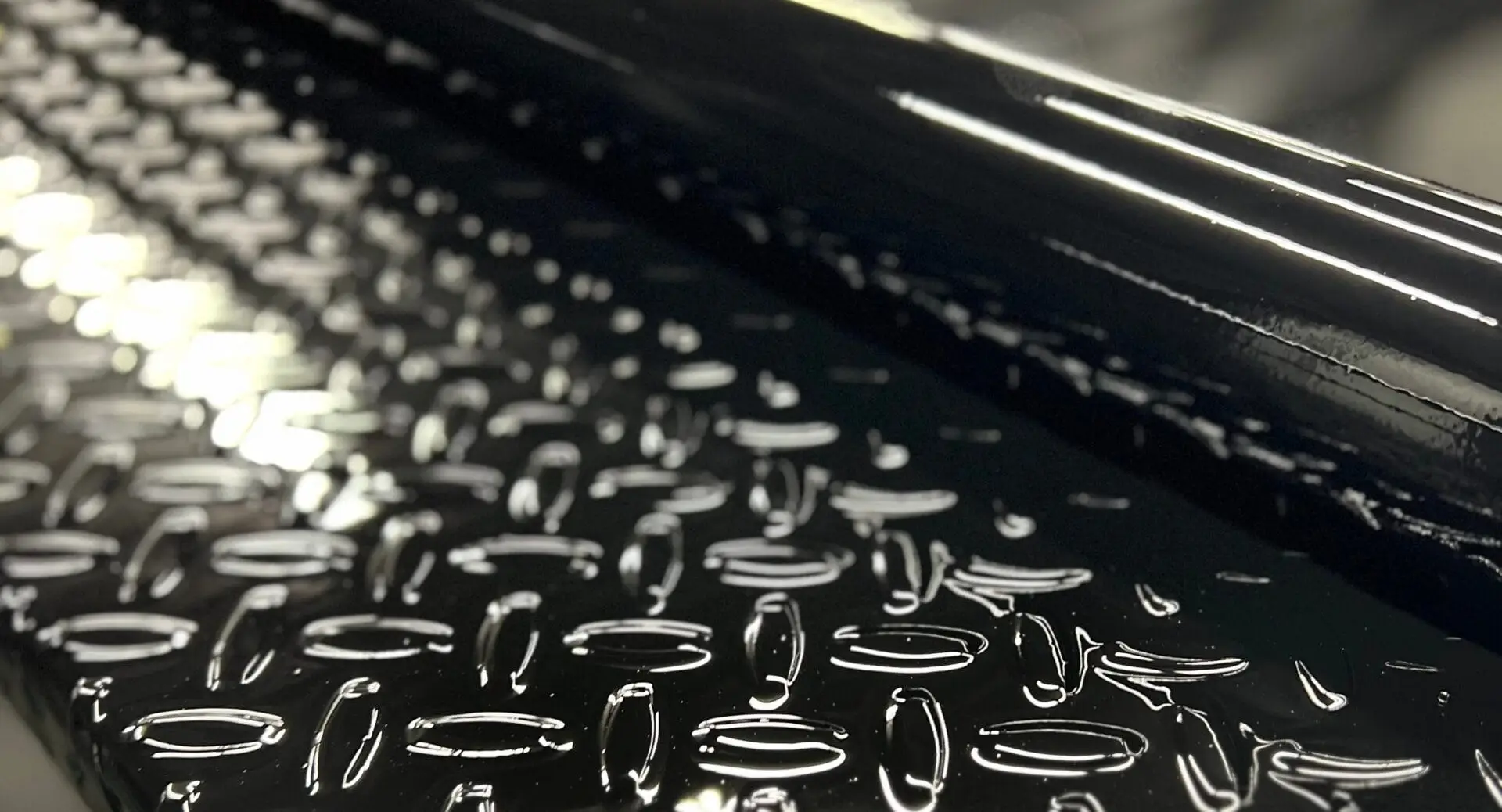
Two trailers can look nearly identical sitting on a dealer’s lot and have very different coating systems underneath that shine. If you’re comparing them on price, paint is one of the areas worth understanding before deciding that one trailer simply costs more than another.
So which trailer paint is better? My answer is to stop looking for a coating that’s universally “better.” Look at how it protects the steel, how it handles damage, and what it takes to repair it. For a working trailer, repairability matters a lot more to me than most people realize.
Why trailer paint matters
Paint is easy to treat as cosmetic. I don’t look at it that way.
A trailer spends its life outside. It gets hit with rocks. Chains get dragged across it. Equipment gets loaded and unloaded. Livestock trailers see manure and other contaminants. Road grime collects on the frame. Eventually, something is going to scratch or chip the finish.
That’s why I look beyond how good a trailer looks the day we finish it. I want to know what happens years later.
Can we repair the coating? Can we reasonably match it? If a small area gets damaged, can we keep that damage contained? What is it going to cost the owner to maintain the trailer over its life?
Those questions have driven a lot of our decisions at Texline.
Acrylic enamel trailer paint
For many years, we’ve used an acrylic enamel system on our trailers.
Our acrylic is a 141 Series HS Premium Acrylic Enamel supplied by Love & Associates. The paint and chemicals are mixed specifically for our application.
Acrylic has served us well because it is repairable. That’s a big deal on a working trailer.
The downside is that acrylic is a relatively soft finish. We address that by adding a chemical hardener. That improves surface hardness and gloss retention while giving the finish greater resistance to impact.
Our acrylic system uses three coats. We start with a rust-inhibitive primer, a 29 Series Rust Inhibitive Universal/Tie Coat Primer. It is followed by two finishing coats of acrylic enamel.
The primer has another job besides helping us build a good finish. If the top coat gets chipped or damaged, that primer helps keep moisture from traveling underneath the surrounding finish. That gives the owner time to address the damaged area before it spreads.
Why we are moving to polyurethane
We’re now moving permanently from acrylic enamel to a polyurethane coating system.
We didn’t make that decision because acrylic suddenly became a bad product. We made it because we’re always looking at the long-term ownership experience.
Polyurethane gives us better long-term color and gloss retention, improved resistance to UV exposure and chemicals, and a harder finish. That matters on something that’s going to spend most of its life outside.
Texas sun is hard on equipment. So are road grime, chemicals, livestock environments and normal use.
There is additional cost to us in moving to polyurethane. We aren’t charging the customer an additional amount for the polyurethane finish. We’re absorbing that as part of the standard build because we believe the improvement in durability and long-term appearance justifies the investment.
Our polyurethane process is different from our acrylic process. It is a one-coat system applied directly to properly prepared bare steel. There is no separate primer underneath it.
Paint preparation matters
You can buy good paint and still end up with a poor finish if the steel underneath it wasn’t prepared correctly.
Before we apply our coating, the steel has to be cleaned with solvents to dilute and remove grease and contaminants from the surface. We do this by hand.
It’s a two-step process that includes a cleaning inspection. We’re trying to get the steel as close to ideal condition as we reasonably can before coating it.
That preparation isn’t the part most customers are going to notice on a new trailer. They see the finished color. But what is underneath that finish matters.
Is powder coating better than paint?
This is probably the biggest misconception I hear about trailer coatings.
People have been told that powder coating is better than paint. I think that’s too broad of a statement. Every product has its application.
Powder coating can make a lot of sense on smaller or removable parts. It can also be a good choice for high-contact components or parts where you want a very hard, uniform finish.
That doesn’t automatically make it the best choice for an entire fabricated trailer.
My biggest concern is repairability. A trailer is a tool. I believe a tool should be reasonably easy to repair because that affects its lifetime value and long-term cost of ownership.
If we damage one small section of a repairable liquid coating, we can address that section. Repairing a powder-coated structure can be considerably more involved. Properly restoring a damaged powder-coated area can require removing the existing coating, recoating the area and curing the new powder.
That’s a very different repair process.
We put the coatings through an impact test
We wanted to see the difference ourselves.
We tested powder coat, our acrylic system and polyurethane by shooting coated samples with 12-gauge birdshot from 30 feet. This wasn’t a standardized laboratory test. It was our own practical comparison.
What we saw was interesting.
On the powder-coated sample, the impacts caused the coating to flake. The hard surface reacted almost like shattered glass around some of the impact points. Over time, the larger affected area continued to flake.
The acrylic behaved differently. Damage stayed closer to the individual impacts, although the impact spots were larger.
Polyurethane performed the best in our test. The affected areas were limited to where the shot actually made contact. We didn’t see the cracking around those impacts that we saw with powder.
That experience reinforced what we were already considering. Hardness alone doesn’t tell me everything I want to know about a trailer coating. I also care about how the coating behaves after it gets hit.
Repairability is the difference I want buyers to understand
If you ask me what matters most when comparing powder coat to a good liquid coating on a trailer, my answer is simple.
Ability to repair it.
Eventually, working trailers get damaged.
With our repairable coating systems, a typical small damaged area can generally be addressed by lightly sanding the area by hand to establish good adhesion and applying the proper matching touch-up coating. We can overnight matching touch-up cans when one of our customers needs them.
That doesn’t mean every damaged trailer can be repaired with a spray can. Major coating damage is different. But a normal chip or scratch shouldn’t necessarily turn into a major refinishing project.
That’s one of the reasons I believe choosing the right coating from the beginning matters.
Can you repaint an older trailer?
Yes, but the right way to repaint a trailer depends heavily on what’s already on it.
If we’re talking about completely refinishing an older trailer, I prefer a full sandblast. It gives you a properly prepared surface to start over with.
This is also why I tell buyers to think about the coating before they buy the trailer. You might own that trailer for 10 or 15 years. The finish will eventually need attention. I’d rather start with a coating system that gives me practical options later.
What trailer paint color should you choose?
Color is partly personal preference, but it also matters over the life of the trailer.
Different colors show UV exposure, scratches and repairs differently over time. More importantly, I want a proven coating system that can be maintained and reasonably matched years later.
Our paint and chemicals are mixed specifically for our application in 100-gallon batches. Because of that, we try to stay away from very unusual one-off colors. We can customize non-metallic coatings when needed.
Our current Texline color chart includes Black, White, Fire Red, Candy Apple Red, Midnight Blue, Tactical Green, JD Green, Kawasaki Green, CAT Yellow, Kubota Orange, Sequoia Brown, Industrial Gray, Moonrock Gray, Silver Silver, Smoked Charcoal and Royal Blue.
I wouldn’t choose a trailer based on color alone. I would choose the color you like, then make sure you understand the coating underneath it.
How to inspect trailer paint before you buy
You don’t have to be a painter to take a closer look at a trailer finish.
Look at the coverage. Check different areas of the trailer and make sure surfaces are properly covered.
Then look at the finish itself. We shoot for a deep, mirror-like finish. You shouldn’t see obvious orange peel or wrinkling across the painted surface.
At Texline, our trailers are inspected throughout the coating process. With our multi-coat acrylic process, the trailer is inspected after every coat.
A nice finish doesn’t tell you everything about the coating system, but poor application can certainly give you reasons to ask questions.
How to take care of trailer paint
Good paint still needs basic care.
- Wash the trailer regularly, especially after exposure to manure, road salt, fertilizer, mud or chemicals. Leaving contaminants against the coating can create more problems than normal weather exposure.
- Pay attention to areas that take abuse. The tongue, fenders, front-facing rails, floor edges, ramps and areas around chains are good places to inspect periodically.
- If you find a chip or scratch, address it early. With polyurethane, damaged areas can typically be cleaned and prepared, primed if necessary, and recoated locally.
- Keep aggressive chemicals away from the finish. Strong acids, alkaline cleaners, brake fluid, certain solvents and harsh degreasers can damage or dull coatings.
- If appearance matters to you, an automotive-type wax or compatible paint protectant can help maintain the gloss and make the trailer easier to clean.
Most importantly, don’t ignore exposed steel. If you see rust beginning, remove the oxidation, prepare the area correctly, prime it where necessary and touch it up before corrosion has an opportunity to travel farther underneath the coating.
Why our paint supplier matters to me
We use Love & Associates as our paint supplier.
I value consistency, product quality, technical support and the relationship behind the product.
We don’t make supplier decisions based only on who gives us the lowest price per gallon. Paint problems don’t stop being our problem because we saved money buying the material.
I want a supplier that understands our application and the environment these trailers operate in. I also want knowledgeable people available when we need to troubleshoot something or evaluate a different product.
That’s part of how we ended up moving toward polyurethane. The coating itself matters. So does the preparation, application and support behind it.
What I would ask before buying
If you’re comparing two trailers and one costs more, don’t let somebody tell you “ours is powder coated” or “ours is painted” and treat that as the end of the conversation.
Ask them why they believe their coating is the better option. Then listen to the answer.
I would want to hear about what happens after the trailer gets scratched. I would want to understand how the coating is repaired. I’d ask what kind of preparation happens before the coating goes on and whether matching material will be available later.
The trailer industry has been trained to sell trends at times instead of explaining the functional advantages behind them.
I’m not asking you to take my side. Ask the questions. A manufacturer should be able to explain why they chose the coating system they’re putting on a trailer you’re going to own for years.
See how we paint a Texline trailer
If you want to see more about how we prepare and coat our trailers, visit our Paint Process page.
When you’re ready to look at the trailer itself, you have two ways to go. You can view our current in-stock inventory to see what is already built and ready to haul, or head over to Build Your Own Trailer and put together the trailer that fits what you actually need.